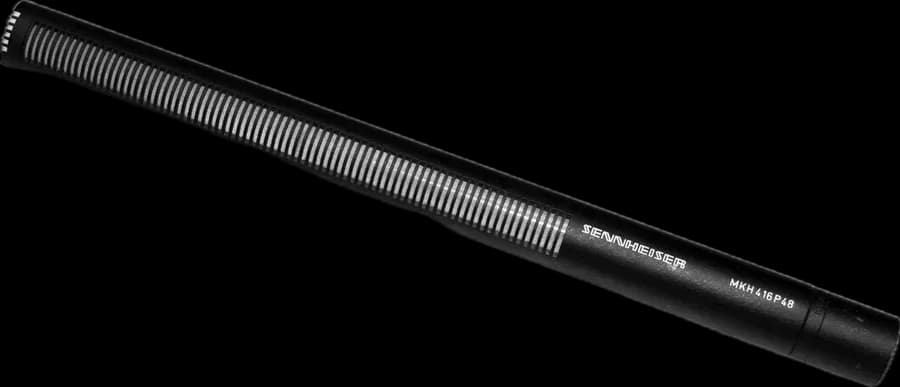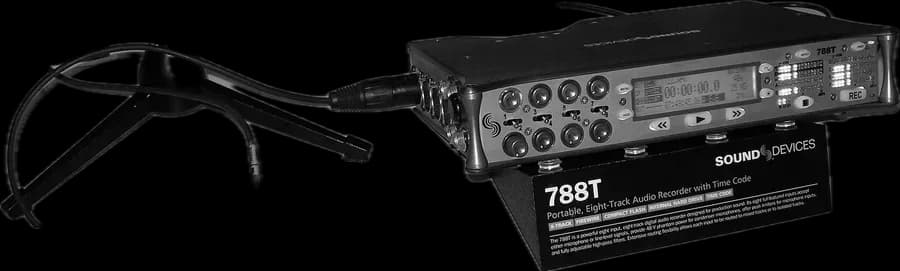
Dialogue comes first, but a film doesn't sound like voices alone. Editorial and post-production need the sound of the place: each room's own “silence” and the ambience around the scene. If it isn't recorded on the shoot, it has to be invented later, and it almost never fits the same way.
Room tone: the silence of the place
No room is silent: there's air conditioning, a refrigerator, distant traffic. Room tone is a recording of that background, with the same microphone in the same position as the scene, with nobody speaking or moving. Editorial uses it to fill the gaps left when cutting between takes so the background doesn't “jump”.
- When the scene wraps, before moving lights or people, ask for silence on the whole set.
- Record 30 to 60 seconds with the boom in its shooting position and the lavaliers on.
- Announce it on the slate or in the take note so editorial can find it.
Ambiences and wild tracks
Besides room tone, longer ambiences are recorded (the street, the market, the jungle, the sea) as well as wild tracks: sounds or lines recorded without camera when there was a noise in the take or the shot didn't allow the microphone to get close. For ambiences, a stereo recording gives post-production far more room than a mono one.
Four stereo techniques
| Technique | How it's set up | Character | Use it for |
|---|---|---|---|
| XY | Two cardioids with capsules together, crossed between 90° and 135° | Precise, somewhat narrow image; sums to mono without problems | Ambiences that might end up in mono, close sources |
| ORTF | Two cardioids 17 cm apart, angled 110° | Natural and wide, close to how we hear | City ambiences, large interiors |
| M/S | A cardioid facing front (M) and a sideways figure-8 (S) | Width adjustable in post-production; mono compatible | Shoots where you don't yet know how much width you'll need |
| A/B | Two spaced omnidirectionals | Very wide and enveloping; worse when summed to mono | Nature, open spaces, music |
M/S needs decoding: stereo is obtained by adding and subtracting the Mid and Side channels, something many field recorders and any editing software can do. Its advantage is that the width is decided after recording.
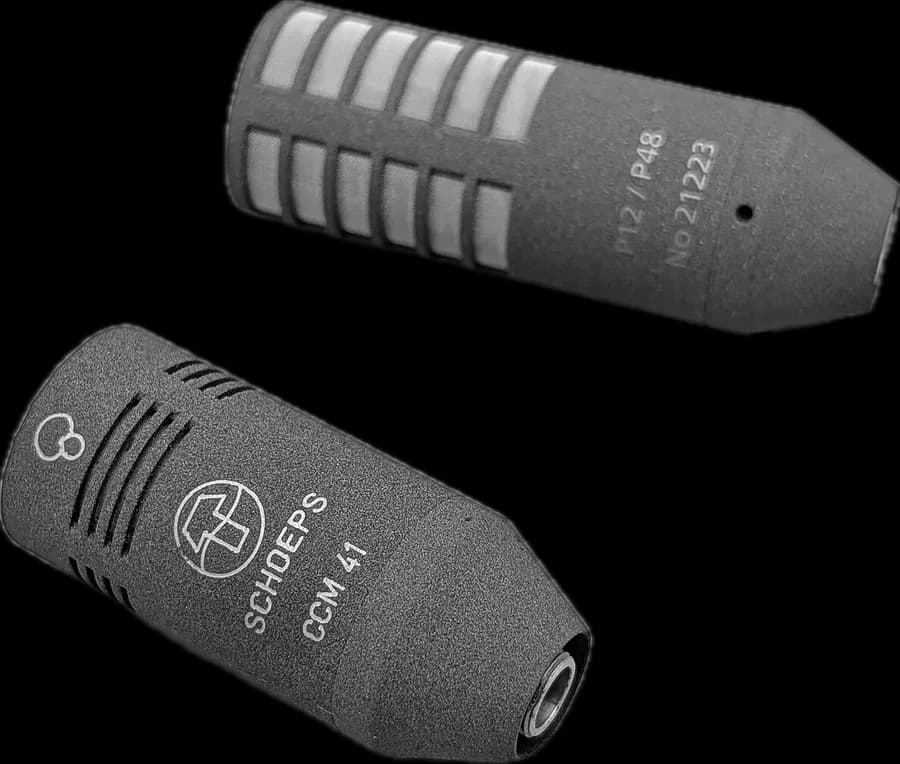
M/S · adjustable width
M/S pair with Schoeps CCM
The CCM 8 (figure-8) is the “S” capsule; for “M” you use a cardioid or, as here, a hypercardioid.
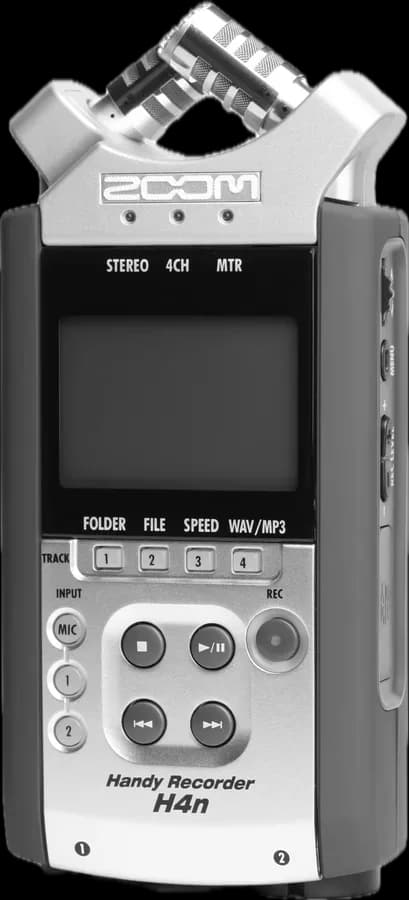
Built-in XY · handheld recorder
Zoom H4n
A recorder with a built-in XY pair: handy for quick ambiences and effects, with less control than a dedicated pair.
Freely licensed photos with the background removed (adaptations of CC BY-SA photos are shared under the same license). Trademarks belong to their manufacturers; they are mentioned for information only.
Tips for recording ambiences
- Record longer than you think: at least two or three uninterrupted minutes.
- Protect against wind just as you would for dialogue; in ambiences, wind ruins more recordings than anything else.
- Move away from the crew and the generators, and note in the file name what it is and where it was recorded.
- A 32-bit float recorder avoids surprises with unexpectedly loud sounds.
Sources and recommended reading
Technical documentation from manufacturers and regulators. Links open external sites.
- Stereo recording (MKH 8000) · Sennheiser ↗
- Stereo recording techniques · LEWITT ↗