A wireless system replaces the cable between the microphone and the recorder with a radio signal. In film, television and live sound it's the tool that lets actors, presenters and musicians move freely. It's also the part of the sound kit most likely to fail if you don't understand how it works.
The parts of the chain
- Microphone: almost always a lavalier on the chest or head; in live sound and interviews, a handheld capsule.
- Transmitter: the bodypack worn by the person, or the body of the handheld mic. It amplifies the audio and turns it into a radio signal on a specific frequency: in analog it compresses it and FM-modulates it; in digital it converts it to data (A/D) and encodes it.
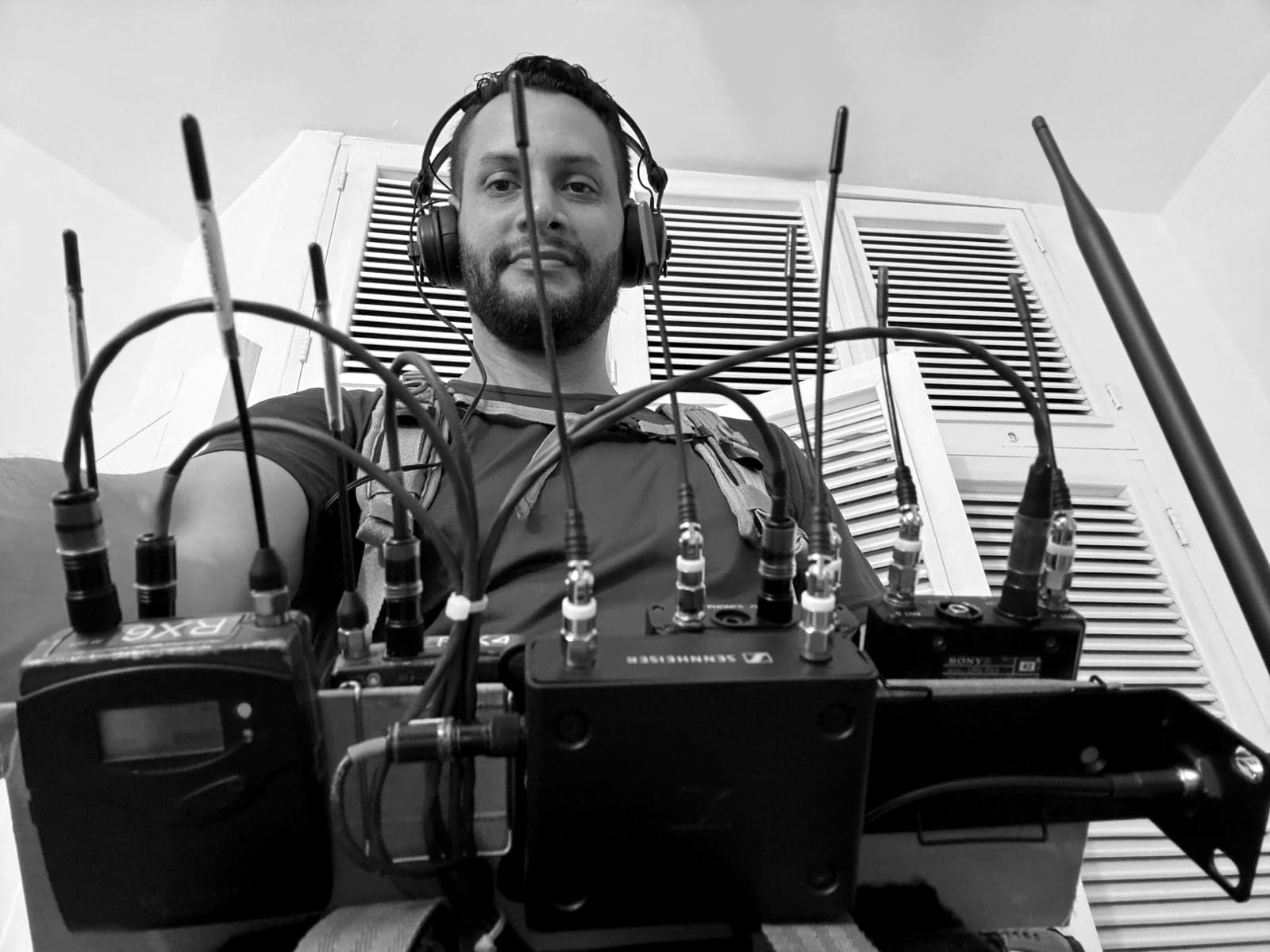
- Antennas: they pick up that signal. Most professional receivers use two (diversity).
- Antenna distribution: in multichannel systems it shares one pair of antennas among all the receivers, instead of filling the set with loose antennas.
- Receiver: it demodulates the signal and turns it back into audio (in analog, by expanding it; in digital, by decoding it and converting it back with a D/A) to feed the recorder or console over a cable.
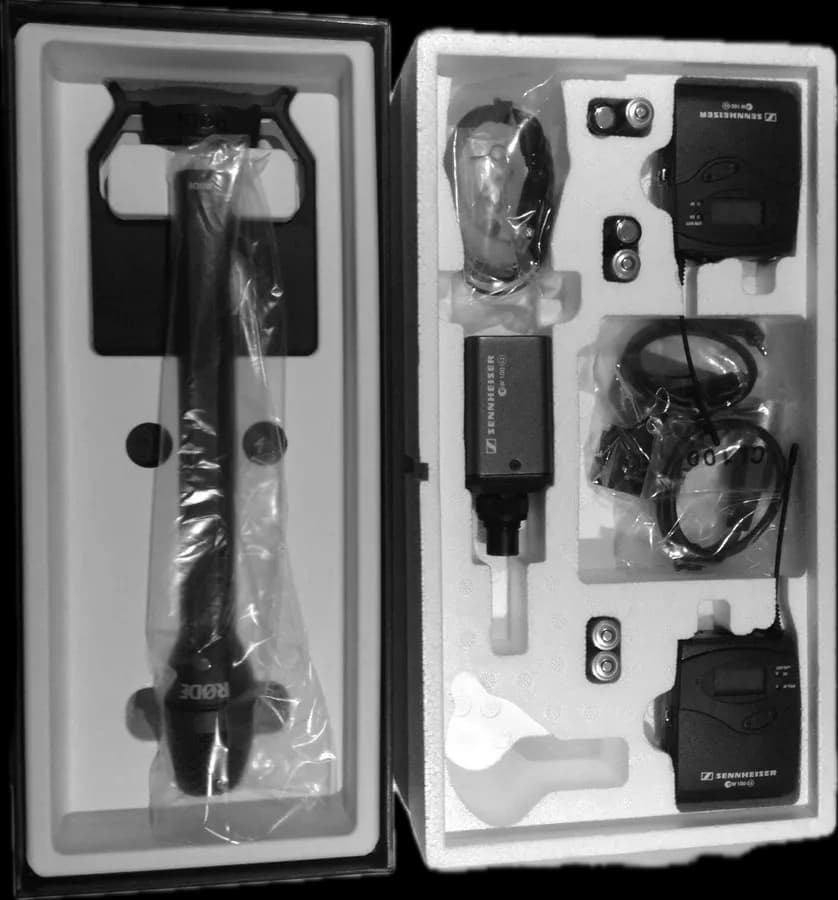
Analog UHF kit · mid-range
Sennheiser EW 100 G3
Portable receiver, bodypack transmitter and handheld transmitter in one case. Very common on small and mid-sized productions.
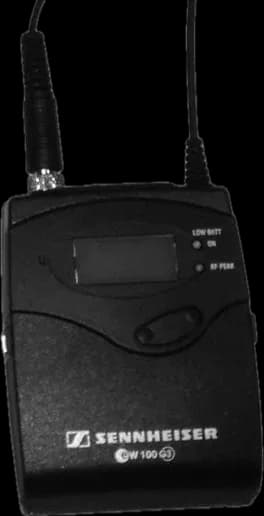
Bodypack
Bodypack transmitter
Worn at the waist or back, it powers the lavalier. Its antenna should be straight and not touching the skin.
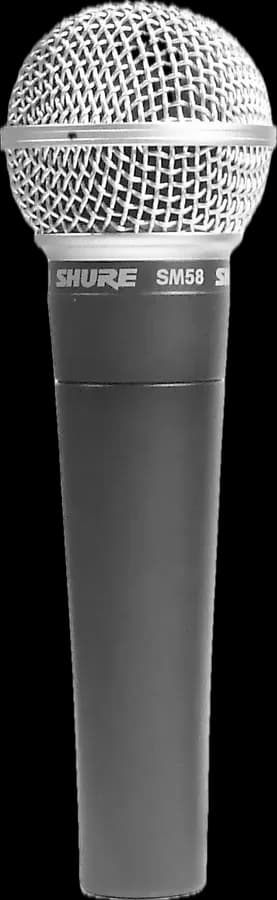
Live sound · since 1966
Shure SM58
The reference handheld dynamic microphone on stage; the same capsule exists in wireless versions.
Freely licensed photos with the background removed (adaptations of CC BY-SA photos are shared under the same license). Trademarks belong to their manufacturers; they are mentioned for information only.
Frequency and power
Professional systems work in the UHF band, between 470 and 900 MHz depending on the model and country. Each transmitter takes up one channel and can't share it with another: two transmitters on the same frequency interfere with each other. That's why a set with many microphones needs frequency coordination, which we explain in the RF guide.
Transmitter power (usually 10, 50 or 100 mW on production equipment) isn't a volume control: more power gives more range, but also drains the battery faster and can cause intermodulation when many devices are close together. The norm is to use the lowest power that covers the shot's actual distance.
Diversity: why there are two antennas
Radio signals reflect off walls, vehicles, metal structures and water surfaces such as a lake or the sea. Water does both things: its surface reflects the signal, while the water inside the human body absorbs it. Reflections don't go away: at some points the direct and reflected signals arrive out of phase and cancel each other out. That's multipath, the cause of many brief dropouts. A diversity receiver listens through two separate antennas and uses whichever is receiving better at each moment; it's very unlikely that both lose the signal at the same time.
λ = 300 / f (MHz) → λ in meters
At 500 MHz the wavelength is 60 cm, so diversity antennas should be at least 15 cm apart. At 600 MHz, a quarter-wave whip antenna is about 12.5 cm long.
Why the signal drops out on set
| Cause | What happens | How to avoid it |
|---|---|---|
| The body blocks the signal | The human body absorbs RF; a transmitter on the back loses range toward the front. | Transmitter antenna straight, not coiled and not touching the skin; receiving antennas with line of sight to the actor. |
| Badly placed antennas | Antennas behind metal, on the ground or inside the sound cart. | Raise them and get them out of the cart; use low-loss coaxial cable or directional antennas for long distances. |
| Interference | Another device, a TV channel or an intermodulation product lands on your frequency. | Scan the spectrum at the location and coordinate every frequency on set, not just sound's. |
| Low battery | The transmitter loses power or shuts off mid-take. | Change batteries on a plan (per day or by hours), not when the indicator warns you. |
In live sound
Concerts and events add in-ear monitors (IEM), which are wireless transmitters going the other way: from the stage to the musician's ear. They share the same UHF band with the microphones, so mics, in-ears and intercoms are coordinated together. In film the same applies to IFB returns for the director and script supervisor.
Sources and recommended reading
Technical documentation from manufacturers and regulators. Links open external sites.
- Analogue vs digital wireless · Shure ↗
- Wireless RF: antennas, diversity and distribution · Sennheiser ↗
- Wireless microphones · FCC (United States) ↗