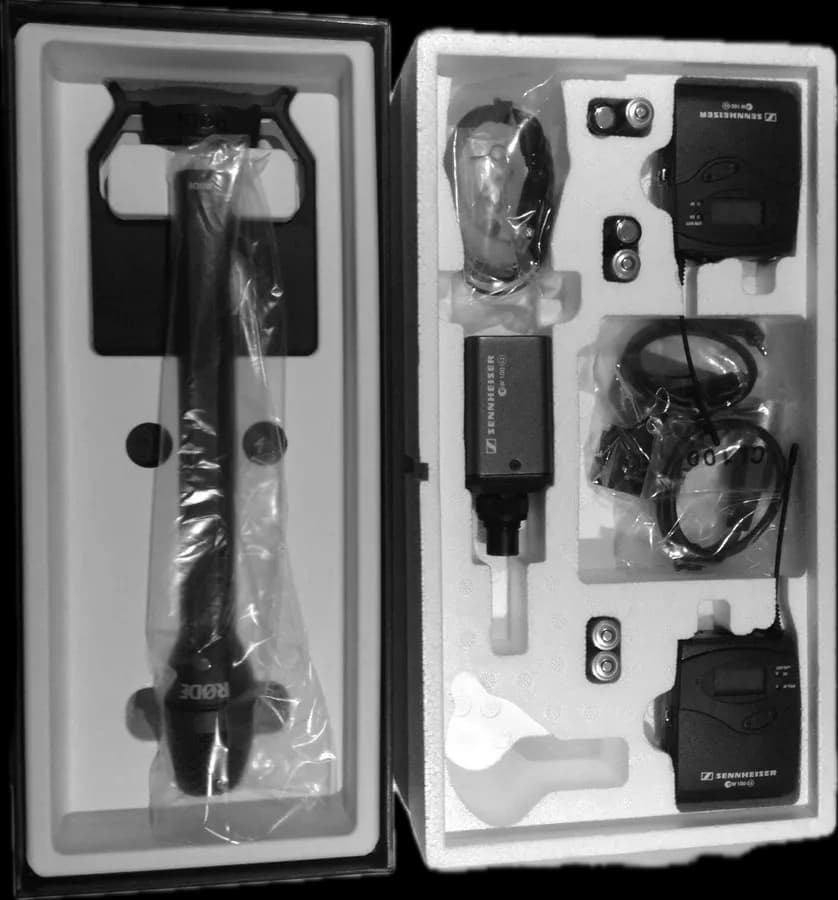
In just a few years, compact 2.4 GHz wireless systems have become common in interviews, social media and light documentaries. UHF systems are still the backbone of fiction shoots, reality shows and television. They don't compete on audio quality, which is high in both today: the difference lies in how the radio signal behaves and how many channels can be coordinated at once.
Two very different bands
| UHF (470–900 MHz, depending on country) | 2.4 GHz (ISM band) | |
|---|---|---|
| Wavelength | About 33 to 64 cm | About 12.5 cm |
| License | Regulated by each country; in the DR, by INDOTEL | License-free almost everywhere |
| Shared with | Digital TV and other authorized services | Wi-Fi, Bluetooth, microwave ovens and other devices |
| Typical power | Adjustable, usually between 10 and 100 mW | Limited by the license-free band rules |
| Coordination | Fixed frequencies chosen after scanning | Automatic: the system hops between frequencies |
λ = c / f → 300,000 km/s ÷ 2,400 MHz ≈ 12.5 cm
Wavelength (λ) is the speed of light divided by the frequency. At 600 MHz it's about 50 cm; at 2.4 GHz, about 12.5 cm. The shorter the wave, the harder it is for it to get around obstacles and the more the human body and materials absorb it.
The body, the walls and Wi-Fi
The human body is mostly water and absorbs radio energy, and that absorption increases with frequency. A bodypack on an actor's back, with their body between the pack and the receiver, loses more signal at 2.4 GHz than in UHF. The same happens with walls, vehicles and dense vegetation.
The 2.4 GHz band is also the Wi-Fi and Bluetooth band. On a set with dozens of phones, routers, wireless video monitors and camera controls, the spectrum fills up. 2.4 GHz systems defend themselves by frequency hopping, but they can't pick a clean frequency and stay on it the way a coordinated UHF system does.
How many channels at once
A reality show or a series may need 16, 24 or more wireless microphones working at the same time, along with IFB and intercom. In UHF that's solved with frequency coordination that avoids intermodulation. 2.4 GHz systems usually support few transmitters per receiver (two or four on current models) and aren't designed to scale to dozens of channels in the same space.
Latency and sync
Every digital system adds a few milliseconds of delay for conversion and coding. With a single microphone it isn't noticeable, but when mixing a digital lavalier with a cabled boom, or using several different systems in the same scene, the differences in delay can produce a hollow sound when they're summed. Each model's latency is listed in its spec sheet, and it's worth comparing before combining systems.
Internal recording and timecode
Many current compact transmitters record inside the bodypack, in 32-bit float, and some with timecode. It's a good safety net: if the radio drops out, the audio is saved. UHF transmitters with internal recording exist too. In both cases the backup file has to be retrieved, synced and delivered, which adds time to the day's offload.
When each one makes sense
| Situation | Usually works well | Why |
|---|---|---|
| Interview with 1–2 people, camera close by | 2.4 GHz or UHF | Short distances and few channels |
| Social media content, travel, minimal kit | 2.4 GHz | Light, no coordination and internal backup |
| Fiction with several actors moving | UHF | Better penetration through bodies and obstacles |
| Reality or TV with many microphones | Coordinated UHF | Dozens of channels without interfering with each other |
| Location with lots of Wi-Fi (hotels, offices, trade shows) | UHF | Doesn't share the band with data networks |
Sources and recommended reading
Technical documentation from manufacturers and regulators. Links open external sites.
- ISM radio band · Wikipedia ↗
- Wireless microphone licensing · Wikipedia ↗
- Sony ECM-W5 (internal recording and timecode in the transmitters) · Sony ↗