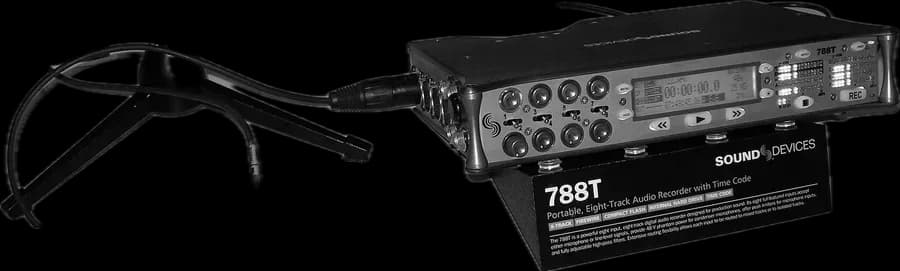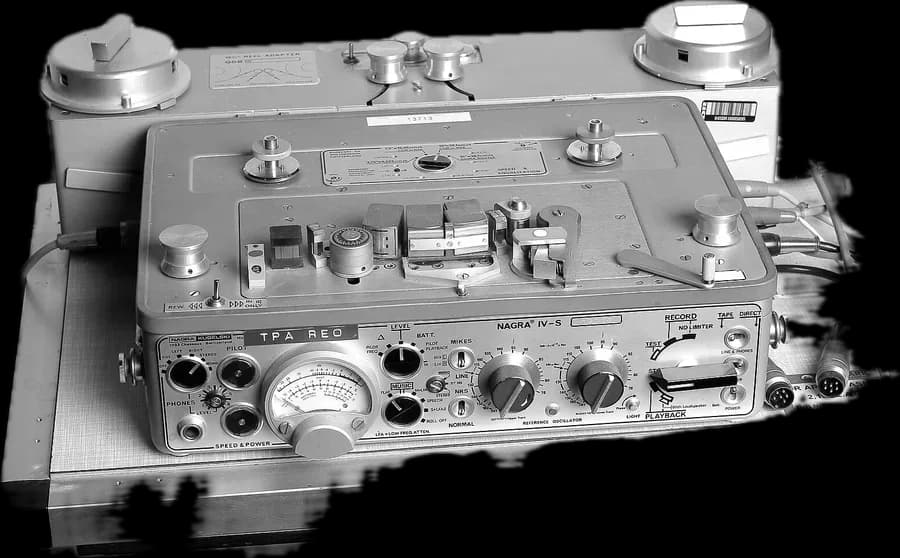
A mixer reads 0 VU, the camera reads -20 and the recorder -18. None of them is wrong: each device uses a different scale. Understanding those scales is what lets you send audio to cameras, IFBs and recorders without it arriving clipped or too low.
The three scales used on set
| Unit | What it measures | Reference (0 dB) |
|---|---|---|
| dBu | Voltage in professional equipment | 0.775 V |
| dBV | Voltage in consumer equipment | 1 V |
| dBFS | Digital level inside the recorder | The maximum that fits in the file (full scale) |
Professional line level is +4 dBu (about 1.23 V); consumer level is -10 dBV (about 0.32 V), almost 12 dB lower. Connecting a professional output to a consumer input, or the other way round, is a common cause of clipped audio or noise in camera.
dBu = 20 · log₁₀ (V / 0.775 V) +4 dBu ≈ 1.23 V
Decibels compare a voltage with its reference. Roughly every 6 dB, the voltage doubles.
dBFS: the digital ceiling
In digital, 0 dBFS is the highest value that can be written to the file. In a 24-bit recorder, a signal that goes over that ceiling is clipped and can't be recovered. That's why digital levels are always negative, and headroom is left above the dialogue for shouts, bangs or sudden changes.
Reference tone
So that every device in the chain speaks the same language, a 1 kHz tone is sent at an agreed level and each input is adjusted until it reads the same. There are two main conventions:
| Standard | Usual region | Equivalence |
|---|---|---|
| SMPTE RP 155 | US and productions following the US standard | +4 dBu = -20 dBFS |
| EBU R68 | Europe | 0 dBu = -18 dBFS |
Setting gain
- Ask the actor to say their lines at the scene's real volume, not quieter “just to test”.
- Set the preamp gain so normal dialogue sits with generous headroom, and the loudest peaks don't hit the ceiling.
- Use the recorder's limiter as insurance, not as a level tool: if it's working all the time, the gain is too high.
- Send camera a level aligned to its reference tone, so the editorial reference audio is usable.
What changes with 32-bit float
A 32-bit float file can store values far above 0 dBFS, so the file itself doesn't clip: a peak that would have been lost in 24-bit can be brought down later. But the analog chain still has limits. The microphone, preamp and converters can overload before the signal is ever written. Recorders with dual converters reduce that risk, but don't eliminate it.
Sources and recommended reading
Technical documentation from manufacturers and regulators. Links open external sites.
- Line level · Wikipedia ↗
- dBFS · Wikipedia ↗
- EBU R 68: Alignment level in digital audio production equipment · EBU ↗
- How is a 32-bit float file recorded? · Sound Devices ↗