Skip to content

What's new

New microphones, wireless systems and recorders.

Recent launches for film, television and broadcast, summarized from each manufacturer's official announcement. No speakers or live sound: only what's used to record dialogue.

Data taken from manufacturer announcements and the trade press cited in each entry; these are not our own tests. Prices are US launch prices and may vary by country. We have no commercial relationship with these brands. Reviewed on November 2, 2026.

  1. Wireless and RF

    Pre-order

    Announced on

    Sony ECM-W5

    A two-transmitter, one-receiver wireless system that delivers digital audio to the camera through Sony's Multi Interface Shoe, with backup recording in each transmitter.

    Channels
    Up to 4 tracks in camera (kit of 2 TX + 2 optional TX)
    Format
    32-bit float at 48 kHz through the shoe, on compatible cameras
    Backup
    64 GB internal per transmitter (up to 90 h at 32-bit float/48 kHz)
    Sync
    Timecode
    Range
    Up to 500 m line of sight (manufacturer's figure)
    Price
    US$399.99 for the kit; shipping November 2026

    What to check before using it on set

    The main advantage depends on using a compatible Sony camera with digital audio through the shoe. With other cameras or an external recorder, check what outputs the receiver has. Sony doesn't state the radio band in the announcement: confirm it in the spec sheet before planning RF.

    Related guide: 2.4 GHz vs. UHF wireless: what changes on a shoot

  2. Wireless and RF

    Available

    Announced on

    Hollyland LARK M3

    A wireless system expandable to four transmitters and four receivers, designed for interviews and productions with several people and several cameras.

    Band
    2.4 GHz with adaptive frequency hopping
    Channels
    Up to 4 TX and 4 RX
    Format
    32-bit float at 48 kHz
    Range
    Up to 300 m (manufacturer's figure)

    What to check before using it on set

    It works in 2.4 GHz, the same band as Wi-Fi and Bluetooth. It works well for interviews and light formats; on sets with a lot of Wi-Fi or many simultaneous channels, test it at the location first.

    Related guide: 2.4 GHz vs. UHF wireless: what changes on a shoot

  3. Wireless and RF

    Announced

    Announced on

    Deity THEOS D4RX

    A four-channel true-diversity slot receiver, for camera or bag, that works with Deity's THEOS transmitters. It packs eight radio front ends: two per channel.

    Tuning
    550–960 MHz (UHF)
    Channels
    4, true diversity
    Outputs
    4 channels of analog line or AES3, via two TA5 connectors
    Audio
    Encrypted digital; LiveHit DeNoiser on all 4 channels
    Remote control
    Frequency, gain, power and the transmitters' internal 32-bit float recorder, from over 20 m
    Power
    12–18 V via 4-pin connector
    Availability
    Targeted for end of 2026; price not announced

    What to check before using it on set

    Four channels in a single slot receiver simplify a bag or a camera with several lavs. Its range starts at 550 MHz: check it against the location's TV channels and what your country's regulator allows before planning.

    Related guide: Frequency planning in depth: 3rd- and 5th-order intermodulation

  4. Recording

    Announced

    Announced on

    Deity PR-2ii and TC-2

    A new version of the PR-2 pocket recorder and a new timecode box, the TC-2, which keeps devices continuously in sync over Bluetooth.

    PR-2ii
    60% brighter screen, 20+ h on two AA batteries, IP54, microSD up to 1 TB, pre-record
    TC-2
    Continuous Bluetooth timecode; native up to 120 fps (SMPTE ST 12-3)
    TC-2 range
    Up to 70 m wireless, with RP-SMA antenna
    Compatibility
    TC-1 cables and mount; also DBTX, TC-SL1 and PR-2
    Availability
    Shown at IBC 2026; date and price not announced

    What to check before using it on set

    The PR-2ii's continuous wireless timecode will arrive in a firmware update after the TC-2. If you already use TC-1 boxes, check with Deity how both generations will coexist on the same set.

    Related guide: Timecode on set: how cameras and sound stay in sync

  5. Networked audio and sync

    Available

    Announced on

    Audinate Dante: ST 2110 integration and certification in Spanish

    At IBC 2026 Audinate showed Dante equipment working alongside SMPTE ST 2110 systems, the video and audio over IP standard used by broadcast facilities. Since July, levels 1, 2 and 3 of its certification are available in Spanish.

    Broadcast
    Dante ↔ ST 2110-30 interoperability, configurable from Dante Controller
    Management
    Dante Director to manage Dante networks remotely
    Training
    Dante certification levels 1 to 3 in Spanish (July 2026)

    What to check before using it on set

    For mobile units and reality shows that deliver audio to an IP broadcast facility, ST 2110 compatibility avoids intermediate conversions. Before connecting, agree on the PTP clock and stream format with the facility's engineering team.

    Related guide: Dante and networked audio: what it is and how it's used on set and live

  6. Wireless and RF

    Announced

    Announced on

    Wisycom PFL (portable RF over fiber)

    A portable box that carries the antennas' radio signal over optical fiber, so antennas can sit far from the sound cart without coaxial cable loss.

    Diversity
    True diversity over fiber, dual converter
    Connections
    Neutrik opticalCON DUO; Gigabit Ethernet for remote control or Dante
    Power
    Mains or V-lock battery
    Availability
    Shown at IBC 2026; date and price not announced

    What to check before using it on set

    Fiber doesn't lose signal with distance the way coax does: it's the answer when antennas need to be hundreds of meters from the cart, as on reality shows and OB units.

    Related guide: Antennas, cables and distribution: the signal budget

  7. Wireless and RF

    Available

    Announced on

    Sennheiser Spectera SKM

    A handheld mic for Spectera, Sennheiser's bidirectional wideband digital wireless system: one 1RU base station handles up to 32 inputs and 32 outputs across mics, IFB and in-ears.

    System
    Spectera: 6 or 8 MHz carriers in UHF or 1.4 GHz
    Capsules
    New Neumann capsule; adapters for other brands' capsules
    Battery
    Same as the SEK bodypack; new version with 30% more capacity
    Broadcast
    SMPTE ST 2110, Dante, NMOS and Lawo HOME
    Availability
    On sale since September 2026

    What to check before using it on set

    Spectera takes up a whole TV channel (6 or 8 MHz) instead of one narrow carrier per mic. It's planned as a block within the frequency plan, and the 1.4 GHz band depends on each country's regulator allowing it.

    Related guide: Frequency planning in depth: 3rd- and 5th-order intermodulation

  8. Microphones

    Available

    Announced on

    Lectrosonics L1

    A subminiature lav with a Sonaura MEMS capsule, the new mic platform RØDE developed with Infineon. Every unit is matched to the others in sensitivity and response.

    Capsule
    Sonaura MEMS, omnidirectional
    Self-noise
    11 dB(A); signal-to-noise ratio above 83 dB
    Max SPL
    135 dB SPL peak
    Tolerance
    Sensitivity and response matched to ±0.5 dB between units
    Connector
    Black LEMO available; TA5 version announced
    Price
    US$500–700 depending on version and kit

    What to check before using it on set

    Units that all sound the same help when several actors wear lavs and they need to be mixed. Since it's a new capsule technology, it's worth testing sweat resistance and clothing noise with the real wardrobe before a long shoot.

    Related guide: Lavalier microphones: choice, placement and avoiding rustle

  9. Wireless and RF

    Available

    Announced on

    Viviana / Raycom Pebble

    A passive low-profile antenna for bodypack transmitters, worn on the body, that reduces how much of the signal the actor's body absorbs.

    Range
    590–630 MHz (in the US and Canada, 590–608 and 614–616 MHz)
    Connector
    SMA; 50 Ω cables sold separately
    Technology
    BodyWave, with a rear ground plane that pushes energy away from the body
    Price
    About US$199 (retail)

    What to check before using it on set

    It only covers 590–630 MHz: it works if your transmitters are in that range. The back faces the body and the cable must not run in front of the antenna.

    Related guide: Antennas, cables and distribution: the signal budget

  10. Recording

    Available

    Announced on

    Deity PR-4

    A compact four-input, six-track field recorder that records simultaneously to an internal SSD and an SD card.

    Inputs
    2 XLR/6.35 mm combo and 2 3.5 mm minijack
    Format
    32-bit float with dual A/D converters, up to 60 dB of gain
    Recording
    Simultaneous to a 64 GB internal SSD and an SD card up to 2 TB
    Sync
    Wired LTC timecode (3.5 mm) and Deity wireless timecode
    Size
    98 × 80 × 41 mm, 218 g without battery
    Price
    US$449

    What to check before using it on set

    Dual recording to two media is real protection if a card fails. Two of its inputs are minijacks, designed for camera receivers; for professional boom microphones it has the two XLRs.

    Related guide: Field recorders: what sets a professional one apart from a basic one

  11. Microphones

    Announced

    Announced on

    Lectrosonics S1

    Lectrosonics' first shotgun microphone: a lightweight RF-bias condenser developed with RØDE's capsule team (both brands belong to the same group).

    Type
    RF-bias condenser shotgun
    Size
    215 mm long, 19 mm diameter
    Weight
    78 g
    Price
    US$1,639 (expected list price)
    Availability
    Announced for the second half of 2026

    What to check before using it on set

    RF bias is the same technique used by other reference exterior shotguns: it handles humidity better. At 78 g, it lightens the boom on long takes. Check with your distributor whether units are already available in your country.

    Related guide: Boom microphones: shotgun, hypercardioid and boom pole technique

  12. Wireless and RF

    Available

    Announced on

    Wisycom MPR60: multichannel IFB mode

    A firmware update for the MPR60 in-ear and IFB receiver that sends several IFB channels over a single radio carrier.

    IFB
    Up to 3 channels per 200 kHz carrier
    Capacity
    With the MTK982 transmitter: 60 IFB channels in an 8 MHz TV channel, or 45 in a 6 MHz one
    Type
    Firmware for the MPR60 (wideband receiver)

    What to check before using it on set

    Fewer carriers means fewer intermodulation products and more room for mics in the frequency plan, which is very useful on reality shows with many IFBs for producers and directors.

    Related guide: Frequency planning in depth: 3rd- and 5th-order intermodulation

  13. Wireless and RF

    Available

    Announced on

    Lectrosonics IFBT2.0

    An IFB transmitter base station with two independent transmitters in half a rack, compatible with IFBlue bodypack receivers.

    Ranges
    A1 470–537 · B1 537–614 · C1 614–692 MHz
    Inputs
    Analog (line and mic), Dante, AES, Clear-Com and RTS
    Power
    10 to 250 mW in North America; 10 to 50 mW in the EU version
    Format
    Half rack, USB-C, Ethernet and color display
    Availability
    Shipping since June 2026

    What to check before using it on set

    The Dante input lets IFB be fed straight from an OB unit's audio network. It's a continuous transmitter: its antennas stay away from the mic receive antennas.

    Related guide: Antennas, cables and distribution: the signal budget

  14. Recording

    Available

    Announced on

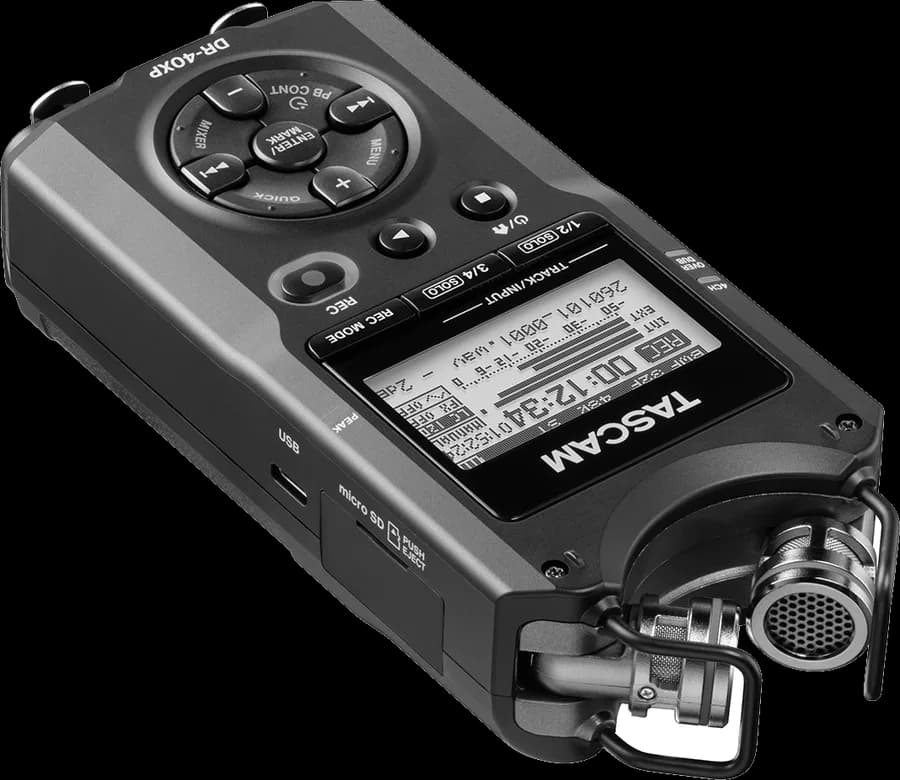
    Tascam DR-40XP

    The third generation of Tascam's four-track handheld recorder, now with 32-bit float recording and two XLR/TRS inputs.

    Format
    32-bit float up to 96 kHz
    Inputs
    2 internal mics (A/B or X/Y) + 2 XLR/TRS: 4 sources at once
    Preamps
    HDDA, equivalent input noise of −126 dBu
    Extras
    Input delay to align phase, sync tone, USB-C interface
    Battery
    Up to 18 h with the internal mics
    Tascam DR-40XP handheld recorder with its built-in mics in X/Y position
    Image: Tascam

    What to check before using it on set

    It has no timecode input: on a shoot with cameras it's synced with a slate or by waveform. Useful as an ambience or backup recorder.

    Related guide: Field recorders: what sets a professional one apart from a basic one

  15. Wireless and RF

    Available

    Announced on

    Sound Devices Astral Mini Plus

    A new version of the Astral series' compact bodypack transmitter, with longer battery life, an extended tuning range and water and dust protection.

    Tuning
    169–1525 MHz (original Astral Mini: 470–1525 MHz)
    Battery life
    Over 8 h on one XL-B14500 rechargeable cell; takes a second cell
    Protection
    IP67 water and dust resistance
    Gain
    GainForward: gain is set from the receiver or mixer
    Handling
    E-paper display, RFID pairing, USB-C charging
    Receivers
    ARX2, ARX8, ARX16, ARX32 and A10-RX

    What to check before using it on set

    The extended range gives more options when coordinating, but each country only allows certain bands: in the Dominican Republic, check which frequencies INDOTEL authorizes for wireless microphones before using the new bands.

    Related guide: RF coordination: UHF spectrum, intermodulation and antennas

    Sources

  16. Microphones

    Available

    Announced on

    DPA 4097 CORE+

    A new version of the 4097 micro shotgun with DPA's CORE+ technology, which lowers distortion. Aimed at speech, choirs, film and broadcast; named best microphone of NAB 2026 by Videomaker.

    Pattern
    Supercardioid (micro shotgun)
    Response
    20 Hz – 20 kHz
    Max SPL
    136 dB peak
    Connector
    DPA MicroLock
    Price
    US$660

    What to check before using it on set

    Its size lets it hide in sets, a car roof or an interview desk, where a boom doesn't fit. It doesn't replace a long shotgun outdoors in noise.

    Related guide: Boom microphones: shotgun, hypercardioid and boom pole technique

  17. Microphones

    Available

    Announced on

    Audio-Technica ATV-SG1 and ATV-SG1LE

    Two on-camera shotguns. The ATV-SG1 has an input to connect a lavalier or a wireless receiver and record it alongside the shotgun.

    Use
    On-camera microphone (not for the boom)
    ATV-SG1
    External input, shoe for a receiver, backup track, built-in filters and gain
    ATV-SG1LE
    Basic version without backup track, filters or gain control

    What to check before using it on set

    It's a solution for cameras that record their own audio, such as light ENG or second unit. On a shoot with a sound department, the main audio still goes from the boom and lavaliers to the recorder.

Does your shoot need this solved on set?

We operate, set up, rent the equipment or advise you before you shoot. Tell us what you're recording.

Request a quote